
Can a Power Station Actually Replace Your Electricity Bill?
A 30-Day Off-Grid Home Theoretic Experiment (2026 Deep Analysis)
Can a Power Station Actually Replace Your Electricity Bill? In 2026, that’s no longer a survivalist daydream, it’s a serious household strategy question. With volatile prices and more visible outage risk in some regions, many homeowners and renters are testing whether a portable power station plus solar panels can shift most, or even all, daily electricity away from the grid.
This 30-day theoretical experiment treats “Can a Power Station Actually Replace Your Electricity Bill?” as a practical engineering and finance problem, using realistic UK household consumption, realistic battery limits, realistic solar output, seasonal variability, and battery degradation over time.
Can a Power Station Actually Replace Your Electricity Bill? Start With Real Household Demand
Before storage, you need demand. Typical UK annual electricity use often lands around 2,700–3,500 kWh per year, roughly 7–10 kWh per day. However, day-to-day reality is spiky. A few high-energy appliances can dominate the outcome, especially electric showers, tumble drying, and oven-heavy cooking.
Typical daily electricity loads, the quiet basics and the big bill-makers
| Appliance | Daily Use (kWh) | Off-grid impact |
|---|---|---|
| Fridge/freezer | 1–1.5 | Always-on baseline load. |
| Router + modem | 0.2 | Small but continuous over 24 hours. |
| Laptop + monitors | 0.8 | Work-from-home can become a core daily load. |
| TV | 0.4 | Evening demand when solar is zero. |
| LED lighting | 0.5 | Mostly night-time draw. |
| Washing machine | ~1 | Works best timed to sunny hours. |
| Kettle (multiple boils) | ~0.7 | High watt spikes test inverter headroom. |
| Electric oven | 2–3 | Drains portable batteries fast. |
| Tumble dryer | 2–4 | Often a deal-breaker without oversizing. |
| Electric shower (per use) | 3–5 | Huge energy and power draw, hardest load. |
Mobile tip: swipe left/right to view the full table.
If your routine leans heavily on electric heating, electric showering, or frequent oven and dryer use, daily demand can rise into 12–15 kWh+. At that point, the question “Can a Power Station Actually Replace Your Electricity Bill?” usually becomes “How much can I reduce it without redesigning my lifestyle?”
Can a Power Station Actually Replace Your Electricity Bill? The 2026 Portable Setup Used in This Experiment
We model a main power station plus expansion batteries for ~6 kWh usable capacity, LiFePO₄ chemistry (3,000+ cycles), and an inverter in the 2,000–3,000W range. It’s capable, but not industrial-scale, which is exactly why winter and multi-day cloud cover matter.
We model 800W–1,000W of solar with MPPT charging. This is powerful on paper, but UK output depends on season, orientation, shading, and cloud cover.
Can a Power Station Actually Replace Your Electricity Bill in the UK? Solar Production Reality
Solar output is the daily “income” that refills the battery. Storage is the buffer. The system succeeds or fails based on what happens when you get several low-income days in a row.
| Condition | Daily Solar Input | Practical meaning |
|---|---|---|
| Sunny summer | 3.5–4.5 kWh | Comfortable recharge window for modest loads. |
| Mixed weather | 2–3 kWh | Normal reality, load timing becomes valuable. |
| Overcast winter | 0.5–1 kWh | Most homes need backup unless oversized. |
A practical year-average estimate is roughly 2.5–3 kWh/day, which explains why “Can a Power Station Actually Replace Your Electricity Bill?” is rarely a clean yes for UK homes without strict load management.
Can a Power Station Actually Replace Your Electricity Bill? What the 30-Day Simulation Shows
With essentials running and heavy loads avoided, daily use around 6–8 kWh can feel workable in good weather. The trade-off is deep cycling almost every day, which is how batteries age faster in real life.
When solar falls to ~1 kWh/day and household use remains near 7 kWh/day, day one feels fine, day two feels tight, day three typically fails without backup or aggressive cuts.
When you boil once and use a thermos, switch some cooking to gas, delay laundry to sunny windows, remove standby draw, and watch consumption with a plug monitor, daily use can drop to 4–5 kWh, and the system becomes dramatically more stable.
Guests, extended cooking, gaming, and laundry can push daily demand into 10–11 kWh. At that point, success usually requires 10–12 kWh of storage and enough solar to refill it, which starts to look like a dedicated home system.
Can a Power Station Actually Replace Your Electricity Bill? Payback Reality for 2026
A strong 2026 consumer-grade setup often lands around £3,800–£5,700 including solar. If a typical home uses ~3,000 kWh/year at ~30p/kWh (~£900/year), then replacing 50% could save ~£450/year and replacing 70% could save ~£630/year. Payback commonly falls around 6–9 years, with battery life strongly influenced by how deeply it cycles.
Outage protection, keeping work online, protecting food, and reducing stress often become the deciding factor. Many buyers justify the system as both a bill reducer and an insurance policy.
Two 2026 Portable Power Stations Built for “Near-Grid” Home Use
If you’re aiming for higher inverter headroom and more realistic multi-appliance support, these are two serious options often discussed for home backup and off-grid capability.
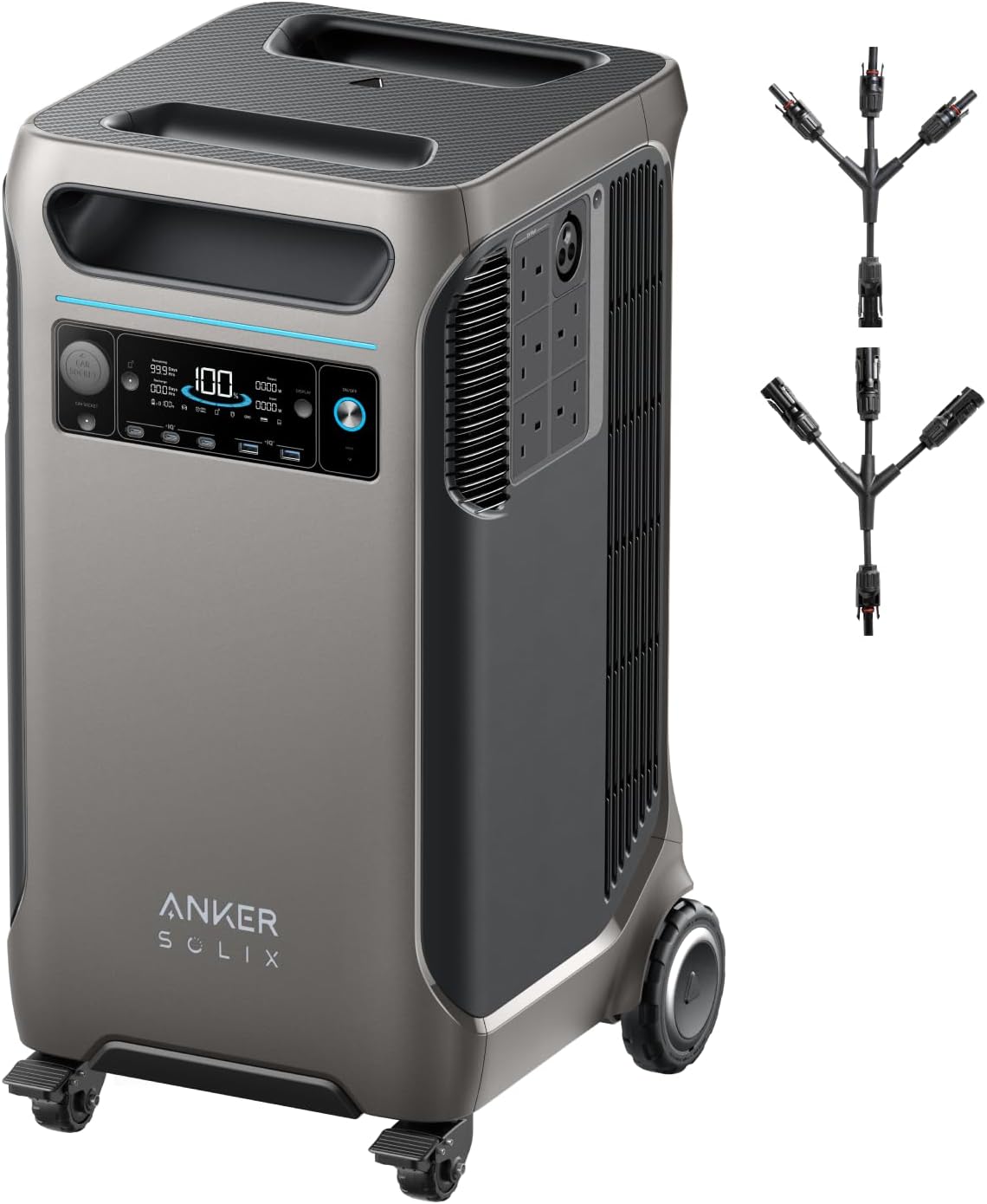
Anker SOLIX F3800
A 6,000W high-output powerhouse featuring native 240V support and EV charging, designed to replace the grid by running heavy-duty UK kitchen appliances and home circuits simultaneously.
Check Price / Availability Back to Top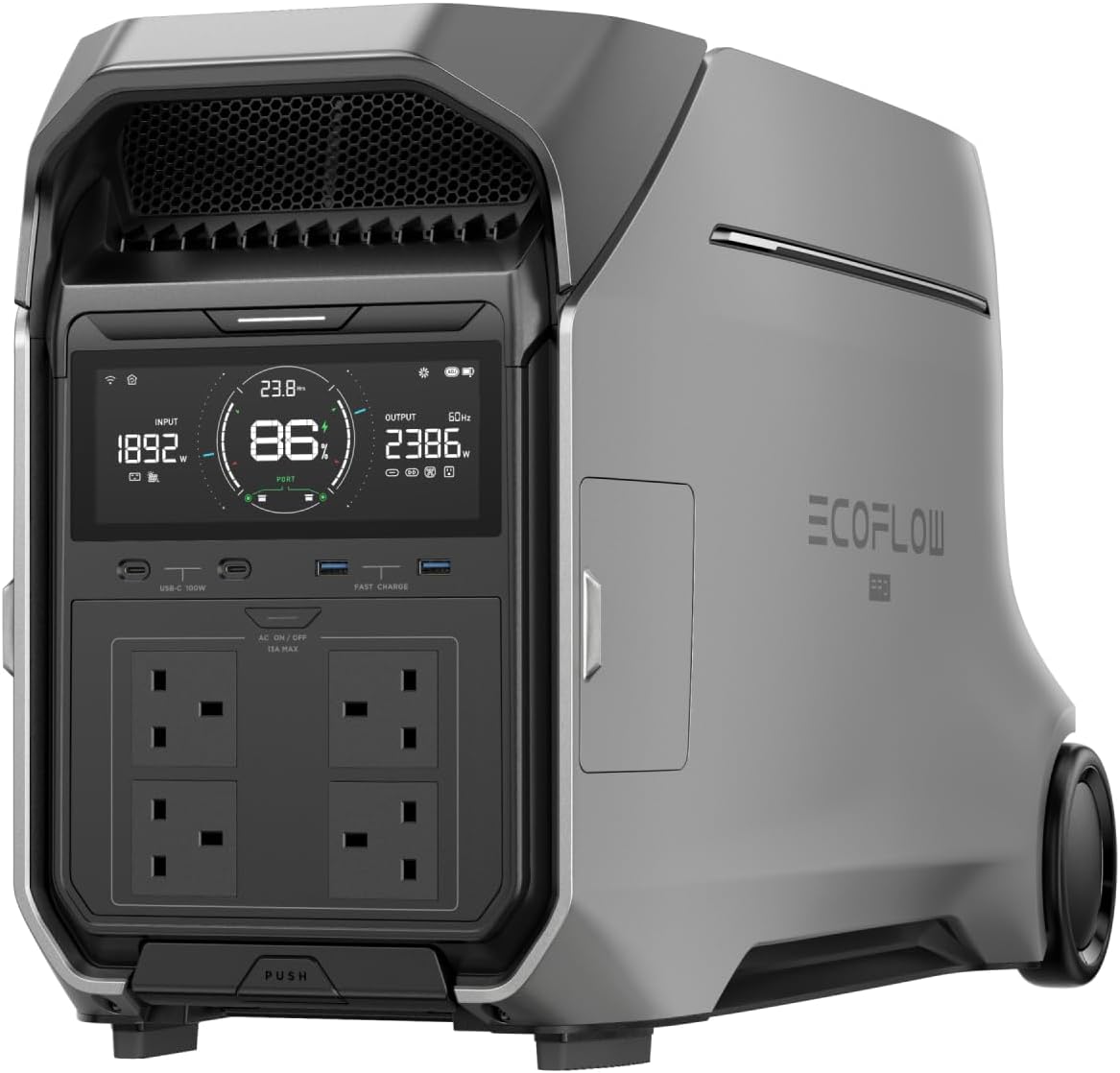
EcoFlow DELTA Pro 3
A whisper-quiet, 4,000W smart energy manager that leads the 2026 market with ultra-fast 50-minute charging and advanced solar harvesting for maximum off-grid efficiency.
Check Price / Availability Back to TopCan a Power Station Actually Replace Your Electricity Bill? The Honest Verdict (UK, 2026)
For most UK households in 2026, fully replacing your bill is rare. Mostly replacing it can be possible with strict load management and realistic expectations. Significantly reducing it is absolutely achievable, especially when solar exposure is decent and high-watt appliances are managed intelligently.
Looking for your ideal portable power station?
Want a model that matches your real daily kWh, your solar conditions, and the appliances you actually use? Check our best picks and choose a setup that’s built for your lifestyle, not marketing claims.
See the Best Picks